Technically, yes. Safely, that’s a different question.
A skin tag has its own blood supply and nerve endings, which is exactly why methods that look simple online often turn out slower, more painful, or riskier than expected.

Published by Dr Hasaneen
Published date 28.08.26
Technically, yes. Safely, that’s a different question.
A skin tag has its own blood supply and nerve endings, which is exactly why methods that look simple online often turn out slower, more painful, or riskier than expected.
Tie a thread tightly around the base to cut off blood supply, and the tissue eventually dies and falls away, the same principle behind a legitimate medical technique called ligation.
In practice, it rarely goes smoothly:

Scissors or nail clippers seem like the fastest option.
But a skin tag bleeds when cut, sometimes more than expected, and non-sterile tools introduce a real infection risk. There is also no way to control depth or precision the way a trained practitioner can.
Applied directly and repeatedly over days or weeks, these are cheap, widely available, and often described online as natural, which explains why they are so often tried first.
What is rarely mentioned: there is very little credible evidence either substance does anything meaningful to a skin tag. What they do reliably cause, particularly apple cider vinegar, is irritation and occasionally a rash from repeated contact with the same small area of skin.

And a prescription from your GP?
In most cases, there isn’t one. Skin tag removal is considered cosmetic, so it sits outside NHS treatment. A GP’s role is usually limited to confirming a lesion is genuinely benign, not to removing it.
Not every small growth that looks like a skin tag actually is one. Warts, moles, and in rare cases something more serious can resemble a skin tag closely enough that a proper assessment genuinely matters, not just for a clean cosmetic result, but to rule out anything that needs medical attention.
– Dr Hasaneen Al Janabi
A lesion with irregular borders, uneven colour, or one that has recently changed in size or appearance should always be looked at by a doctor first, home remedy or otherwise.

Every method above is trying to achieve the same basic outcome, cutting off the tag’s blood supply or destroying its tissue. CryoPen achieves exactly that, properly: in seconds rather than days, with genuine precision rather than guesswork, and after a real diagnosis rather than an assumption made in a bathroom mirror.
Scarring is uncommon with proper aftercare, covered in does CryoPen leave a scar, and the underlying technique is well-evidenced and decades-old, detailed in is CryoPen safe. Treatment starts from £79 per lesion, with the full breakdown in how much CryoPen costs.
Below are some results from CryoPen:

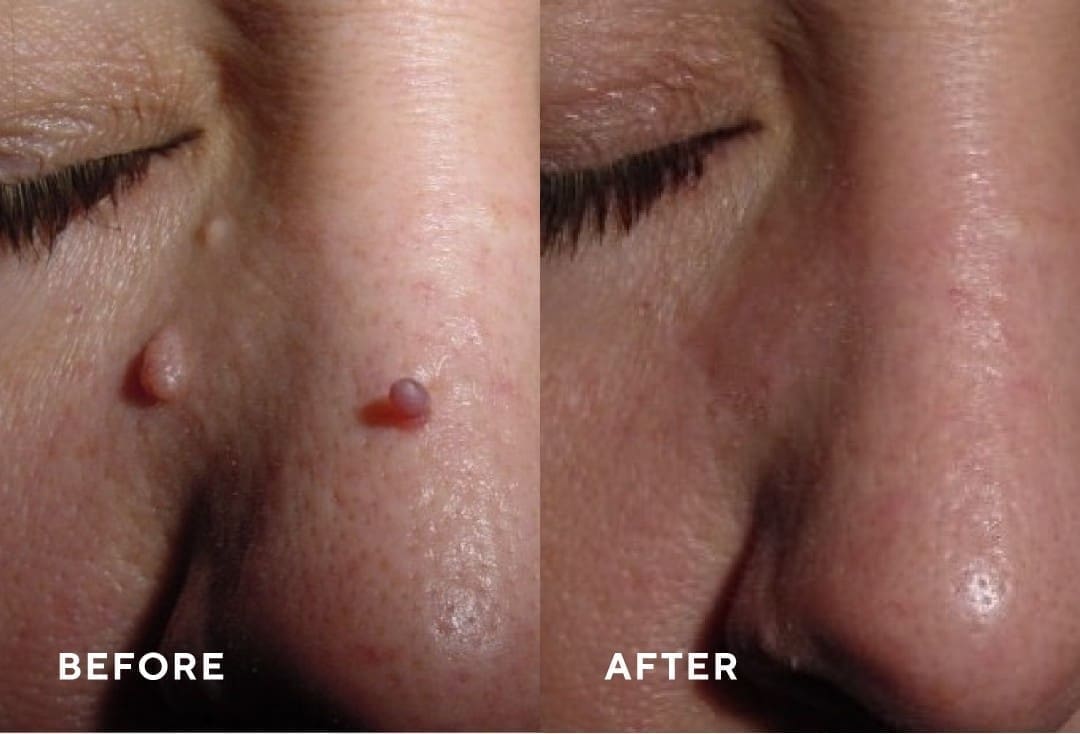

Every lesion is properly assessed by Dr Hasaneen Al-Janabi, a GMC-registered doctor and Member of the Royal College of Surgeons, before any treatment takes place.

The real signs nose filler will work for you, who it won't suit, and what to expect at consultation.

What nose filler actually costs in the UK, what changes the price, and how it compares to rhinoplasty.

Dr Hasaneen Al Janabi explains the real difference between Endolift Body and Laser Liposuction, and the simple test that tells...
Our clients’ satisfaction is at the heart of everything we do. We take immense pride in helping individuals enhance their natural beauty and boost their confidence.


Welcome to our clinic, where innovation, expertise, and personalised care merge to redefine your natural beauty. We specialise in providing a wide range of non-invasive treatments that deliver remarkable results without the need for surgery.