Nasolabial Folds vs Marionette Lines: What’s the Difference?

Dr Hasaneen Al Janabi MBBS MRCS (ENT) - Dr Hass Clinic Founder & Medical Director

Published by Dr Hasaneen

Published date 10.07.26

They often appear together, they are both associated with lower-face ageing, and people regularly confuse them.

However, nasolabial folds and marionette lines are two distinct concerns with different locations, different structural causes, and different treatment approaches

Understanding which one you are looking at changes everything about how it should be addressed.

Marionette Filler Stage Image - Dr Hass Clinic

Where each line sits on the face

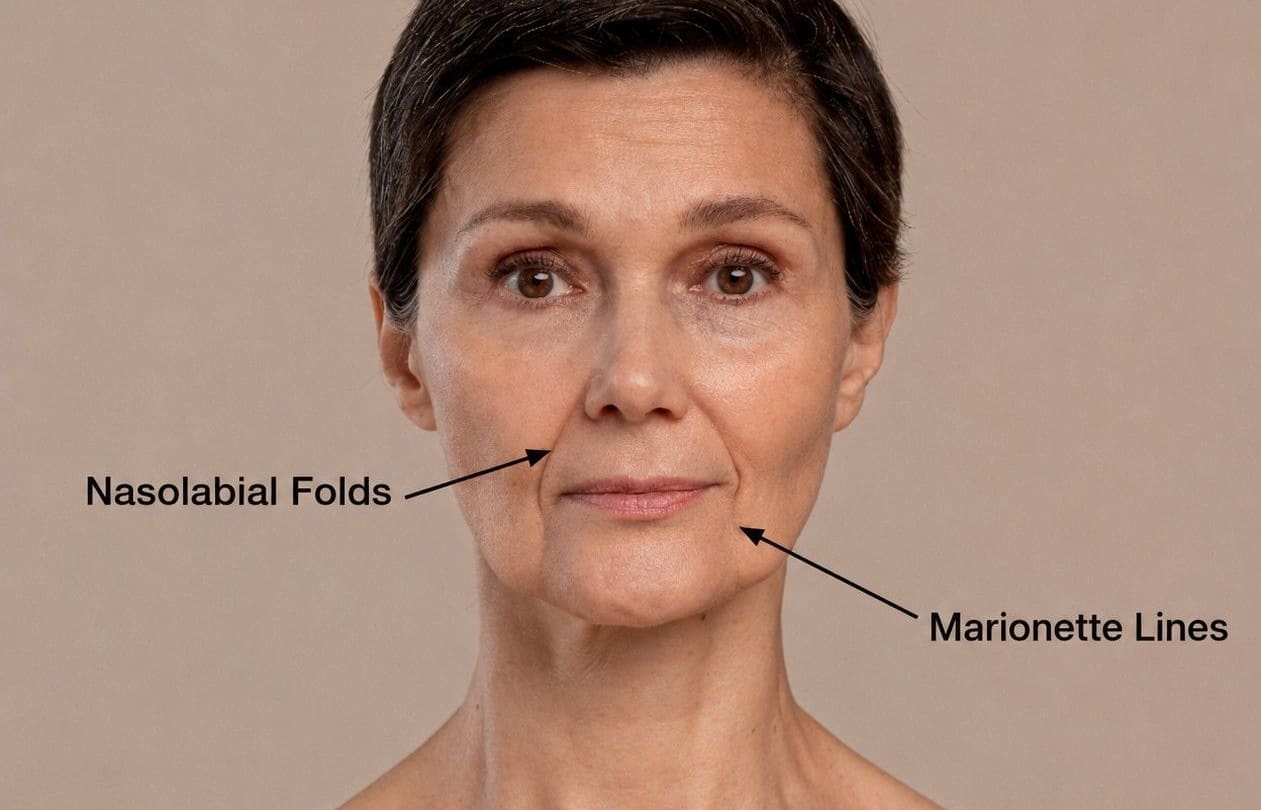
The terms nasolabial folds and marionette lines are often used interchangeably, but they describe two distinct facial features.

Nasolabial folds run from the sides of the nose down to the corners of the mouth. They frame the upper lip and are sometimes called smile lines or laugh lines because they deepen with facial expression. Most people first notice them in their thirties, though their visibility varies significantly based on facial structure, skin quality, and how much mid-face volume has been lost.

Marionette lines run from the corners of the mouth downward toward the chin and jawline. They are named after marionette puppets, whose hinged jaws create exactly this kind of vertical crease at rest. Unlike nasolabial folds, which deepen with expression, marionette lines tend to create a persistently downturned or stern appearance even when the face is completely relaxed.

The simplest way to tell them apart: nasolabial folds are above the mouth corners, marionette lines are below them. Many people have both, with one more pronounced than the other.

What causes nasolabial folds

Nasolabial folds are primarily driven by mid-face volume loss. As we age, the fat pads that sit in the cheeks gradually reduce in volume and descend. This causes the mid-face to lose its structural support, and the skin that was previously held in position begins to fold at the junction between the cheek and the upper lip area.

This is a critical point that many people miss: in a significant proportion of patients, the nasolabial fold is a consequence of what is happening higher up in the face. The fold itself is not always the origin of the problem. When cheek descent is the primary driver, treating the fold directly without addressing the underlying mid-face collapse can produce a result that looks heavy or unnatural.

Contributing factors include:

  • Reduction in facial fat volume in the mid-cheek area
  • Descent of the malar fat pad with gravity and age
  • Loss of skin elasticity reducing the skin’s ability to stay in position
  • Bone resorption in the underlying facial skeleton, which reduces the scaffolding the soft tissue rests on
  • Repeated facial movement over decades, which etches expression lines more deeply into the skin
  • Lifestyle factors including sun exposure, smoking, and weight fluctuation, all of which accelerate volume loss and skin ageing

What causes marionette lines

Marionette lines develop due to structural change and volume loss in the lower face. As support in the jaw and perioral region diminishes with age, the skin around the mouth corners descends. This process is often compounded by the development of early jowling where tissue that was once supported by the cheek migrates downward and pulls the corners of the mouth with it.

The result is a fold that runs vertically from the mouth corner toward the chin, dividing the lower face and creating a wooden or downturned quality to the resting expression. Marionette lines tend to appear later than nasolabial folds because they are driven by more advanced lower-face descent.

Contributing factors include:

  • Loss of volume in the pre-jowl area and along the jawline
  • Descent of the lower cheek and jowl tissue with age
  • Weakening of the retaining ligaments that hold facial tissue in position
  • Reduction in bone density in the lower jaw, which reduces lower-face support
  • Skin laxity that allows descended tissue to remain in its lowered position

How each one is treated

In most aesthetics clinics, the two conditions tend to be treated as follows:

Nasolabial folds are treated with nasolabial filler. Hyaluronic acid is placed within or alongside the fold to restore lost volume and soften its depth. In patients where mid-face descent is the primary driver, addressing the cheeks first often produces a more natural and more effective improvement than treating the fold directly. At Dr Hass Clinic, Dr Hasaneen Al-Janabi assesses the full mid-face context at consultation before recommending an approach. For more on the condition and what causes it, see the nasolabial folds condition guide.

Marionette lines are treated with marionette filler, placed along the line and in the surrounding lower-face area to lift the mouth corners, restore structure, and soften the downturned appearance. Because marionette lines are closely linked to jowl formation and lower-face descent, treatment often benefits from a broader lower-face approach rather than targeting the crease in isolation. For a deeper overview of the condition, visit the marionette lines condition guide.

Both treatments use hyaluronic acid filler, are performed without general anaesthesia, require no formal downtime, and are fully reversible with hyaluronidase. Results typically last 9 to 18 months depending on the volume used, the product, and individual metabolism. For a full breakdown of what to expect after treatment, read our nasolabial filler recovery and aftercare guide.


Below is an example of nasolabial fold filler at Dr Hass Clinic.

Nasolabial Filler - Before and After 1 - Dr Hass Clinic

Can both be treated at the same time?

Yes, and this is common. Because both concerns share the same underlying ageing mechanisms volume loss and tissue descent they frequently develop in parallel. Treating both in a single appointment allows the practitioner to assess the face as a whole and achieve a balanced result across the mid and lower face. Correcting one in isolation, particularly if jowling is also present, can draw attention to the untreated area and leave the overall result looking uneven.

At Dr Hass Clinic, where both concerns are present, Dr Hasaneen will recommend a sequenced or combined treatment plan based on which is the primary driver of the aged appearance and what approach will produce the most natural result.

Benefits of Marionette Filler

What to consider when assessing your own concern

Look at where the crease starts and ends. A line beginning at the side of the nose and ending at the mouth corner is a nasolabial fold. A line beginning at the mouth corner and running down toward the chin is a marionette line.

Consider the effect on your resting expression. Nasolabial folds primarily add to an aged or tired look, deepening on expression. Marionette lines tend to create a downturned or stern quality at rest, regardless of expression because they are pulling the mouth corners down structurally rather than through muscle movement.

Assess whether the concern is one or both. Many patients focus on the nasolabial fold because it is more visible on expression, while the marionette lines which affect the resting face more go unaddressed. A consultation will give you a clear picture of both areas and what is actually driving the concern.

To understand more about whether you are a good candidate for nasolabial filler specifically, read our guide on whether nasolabial filler is right for you.

Nasolabial Filler Treatment Stage Image - Dr Hass Clinic

Treatment at Dr Hass Clinic

All filler treatments at Dr Hass Clinic are performed by Dr Hasaneen Al-Janabi, a GMC-registered surgeon with extensive experience in facial anatomy and lower-face rejuvenation.

Our approach starts not with the individual lines, but with a full assessment of the structural changes driving them, ensuring the treatment we recommend addresses the actual cause rather than just the visible concern.

Latest News

Don’t Take Our Word For it…

Our clients’ satisfaction is at the heart of everything we do. We take immense pride in helping individuals enhance their natural beauty and boost their confidence.

Dr Hass Surgeon-led Aesthetic Clinic Mayfair Waiting Area Dr Hass Clinic - Luxury Aesthetic Clinic Mayfair

Our Clinic

Your Sanctuary

Welcome to our clinic, where innovation, expertise, and personalised care merge to redefine your natural beauty. We specialise in providing a wide range of non-invasive treatments that deliver remarkable results without the need for surgery.

Call us — 020 8168 8178

or