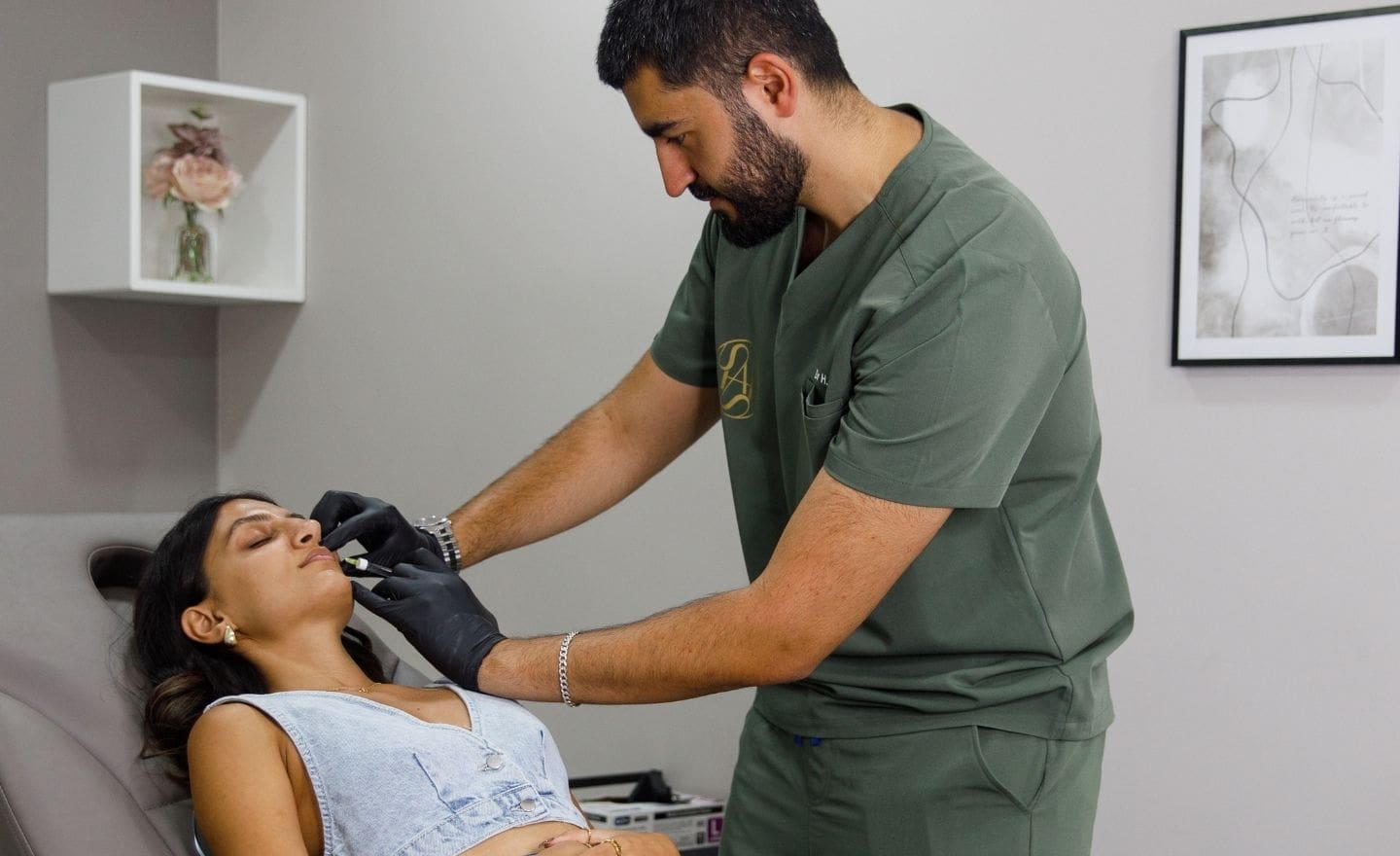
Jawline Filler Recovery and Aftercare

Dr Hasaneen Al Janabi MBBS MRCS (ENT) - Dr Hass Clinic Founder & Medical Director

Published by Dr Hasaneen

Published date 19.03.26

Jawline filler has become one of the most popular non-surgical aesthetic treatments in the UK. By carefully placing dermal filler along the mandibular contour, practitioners can strengthen the appearance of the lower face, improve symmetry and create a sharper jawline profile.

Although the procedure itself typically takes less than 30 minutes, the recovery period plays an important role in achieving the best results. Mild swelling, tenderness and occasional bruising are normal responses as the skin and underlying tissue adjust to the treatment.

Understanding what happens during recovery and how to care for the treated area can make the experience smoother and help ensure the final result appears balanced and natural.

This guide explains what to expect after jawline filler, how long recovery typically takes, and what evidence based aftercare steps practitioners recommend.

Understanding Jawline Filler

Jawline filler treatments usually use hyaluronic acid dermal fillers, a gel-like substance that occurs naturally in the body and plays an important role in maintaining skin hydration and tissue structure.

When placed strategically along the jawline, filler can improve definition and create stronger facial proportions. The treatment is commonly used to:

  • Enhance the mandibular angle
  • Improve jawline definition
  • Balance the chin and lower face
  • Support areas where soft tissue has begun to descend

Because hyaluronic acid gradually breaks down over time, results are temporary. Most patients find that improvements last between 12 and 18 months, although this varies depending on metabolism and lifestyle factors.

Jawline Filler Before - Dr Hass Clinic
Jawline Filler After - Dr Hass Clinic

What Happens Immediately After Treatment

Right after treatment, the jawline may look slightly fuller than expected. This is usually due to a combination of the filler itself and the body’s natural inflammatory response to injections.

It is common for patients to notice:

  • Mild swelling
  • Sensitivity or tenderness
  • Small injection marks
  • Minor bruising

These effects are part of the normal healing process and usually settle quickly.

Clinical research into dermal filler safety has shown that most post treatment reactions are mild and temporary. A review published in the Plastic and Reconstructive Surgery (Global Open Journal) database found that side effects such as swelling, redness and bruising typically resolve without intervention.

Research reference:
https://pmc.ncbi.nlm.nih.gov/articles/PMC6635180/

The review also highlights that practitioner experience and correct injection technique significantly reduce complication rates.

Jawline Filler Recovery Timeline

Although recovery varies slightly between individuals, most patients follow a predictable healing timeline as swelling settles and the filler integrates with surrounding tissue.

First 24 hours

During the first day the jawline may feel firm, slightly tender or mildly swollen. Some patients notice small bumps at injection sites or temporary asymmetry, usually caused by swelling.

Clinics generally advise avoiding:

  • Strenuous exercise
  • Alcohol
  • Excessive heat exposure

These factors can increase inflammation and prolong swelling during the early recovery stage.

Days two to three

Swelling often peaks during the second or third day before gradually improving. If bruising occurs it may become more visible at this stage.

The jawline contour can still appear slightly uneven while the filler settles, which is normal and usually temporary.

Days four to seven

By the end of the first week, most swelling and tenderness have improved significantly. Bruising begins to fade and the overall shape of the jawline becomes clearer.

Many patients start to see the intended aesthetic improvement during this stage.

Weeks two to four

At this point the filler has fully integrated with surrounding tissue and the jawline appears more refined. Any remaining swelling has usually resolved and the final contour becomes visible.

Practitioners often review results at a follow up appointment during this period.

Filler Consultation at Dr Hass Clinic

Evidence Based Aftercare Advice

Following appropriate aftercare recommendations can reduce swelling and support smoother healing.

Most clinicians advise avoiding intense exercise for 24 to 48 hours. Physical exertion increases circulation, which may aggravate swelling around injection sites.

Patients should also avoid alcohol for at least 24 hours, as alcohol can dilate blood vessels and increase the risk of bruising.

Heat exposure can have a similar effect. For this reason, saunas, steam rooms and very hot showers should be avoided on the day of treatment.

It is also important not to massage or press the treated area unless specifically instructed by your practitioner. Gentle facial movement during normal activities is safe, but unnecessary pressure can temporarily disturb the filler while it settles.

Sleeping with the head slightly elevated on the first night may also help reduce swelling.

Managing Swelling and Bruising

Swelling and bruising are the most common temporary effects following jawline filler, although not everyone experiences them.

Simple strategies may help minimise these effects:

  • Applying a cool compress during the first 24 hours
  • Keeping the head elevated while sleeping
  • Avoiding alcohol or strenuous exercise immediately after treatment

Any cold pack should always be wrapped in a cloth rather than placed directly against the skin.

Some practitioners recommend topical arnica products to support bruise resolution, although scientific evidence is mixed.

In most cases bruises resolve within five to ten days, while swelling improves significantly during the first week.

When to Contact Your Practitioner

Although complications are uncommon, patients should always feel comfortable contacting their clinic if recovery does not feel typical.

Symptoms that should be assessed include:

  • Increasing or severe pain
  • Unusual skin colour changes
  • Blistering or skin breakdown
  • Swelling that persists beyond two weeks

These signs are rare but should be evaluated promptly to ensure appropriate management.

For the vast majority of patients, however, jawline filler recovery is smooth and uncomplicated.

Endolift

Factors That Influence Recovery

Several factors can influence how quickly the jawline settles after treatment.

Injection technique is one of the most important. Experienced practitioners place filler precisely within anatomical layers, which reduces trauma and speeds recovery.

The volume of filler used can also affect swelling. Larger treatment volumes may result in slightly longer healing periods.

Individual healing responses vary as well. Some people naturally bruise more easily, and lifestyle factors such as smoking or intense exercise immediately after treatment may prolong swelling.

What Results Look Like After Healing

Once swelling has resolved, jawline filler typically creates a smoother and more defined lower facial contour.

Patients often notice that:

  • The jawline appears sharper
  • The profile looks stronger
  • The chin and jawline appear more balanced

Results generally last between 12 and 18 months, after which the filler gradually dissolves.

Many patients choose maintenance treatments to preserve the effect.

Frequently Asked Questions

How long does jawline filler swelling last?

Most swelling improves significantly within three to five days and resolves almost completely within one to two weeks.

Can I return to work after jawline filler?

Yes. Many patients return to work the same day or the following day because downtime is minimal.

When can I exercise again?

Light activity can usually resume after 24 hours, while intense exercise should wait around 48 hours.

When will I see the final result?

Final results are typically visible after two to four weeks, once swelling has completely settled.

Can filler move during recovery?

Migration is uncommon when filler is placed correctly. Following aftercare advice helps ensure the product remains stable while integrating with the surrounding tissue.

Final Thoughts

Recovery after jawline filler is generally straightforward and predictable, with minimal disruption to daily life. Most patients experience only mild swelling or bruising that improves within a few days.

Clinical research supports the overall safety of hyaluronic acid dermal fillers, and complications remain uncommon when treatment is performed by qualified practitioners with anatomical expertise.

By understanding the recovery process and following professional aftercare advice, patients can help ensure the jawline settles smoothly and the final result appears balanced, natural and well defined.

Latest News

Don’t Take Our Word For it…

Our clients’ satisfaction is at the heart of everything we do. We take immense pride in helping individuals enhance their natural beauty and boost their confidence.

Dr Hass Surgeon-led Aesthetic Clinic Mayfair Waiting Area Dr Hass Clinic - Luxury Aesthetic Clinic Mayfair

Our Clinic

Your Sanctuary

Welcome to our clinic, where innovation, expertise, and personalised care merge to redefine your natural beauty. We specialise in providing a wide range of non-invasive treatments that deliver remarkable results without the need for surgery.