How Many Units of Botox Do You Need? Breakdown by Area

Dr Hasaneen Al Janabi MBBS MRCS (ENT) - Dr Hass Clinic Founder & Medical Director

Published by Dr Hasaneen

Published date 22.06.26

Botox dosage is not one-size-fits-all. The number of units you need depends on which area is being treated, the strength of your individual muscles, and the result you are looking to achieve.

What does not change are the clinical ranges that guide every well-trained practitioner — and understanding those ranges helps you have a more informed conversation at consultation.

This guide covers typical unit ranges for every major treatment area, explains what drives variation between patients, and sets realistic expectations for first-time and returning patients alike.

A note on terminology: “Botox” is a brand name that has become the common shorthand for all anti-wrinkle injections. The active ingredient is botulinum toxin type A. At Dr Hass Clinic, Dr Hasaneen Al-Janabi uses premium botulinum toxin products, and unit ranges are comparable across equivalent products.

How many units of botox do you need per area - Table by Dr Hass Clinic

Frown lines (glabella) — 15 to 25 units

The frown lines between and just above the eyebrows, often called the “11s”, are the most commonly treated area with Botox worldwide. The muscle group responsible is called the glabellar complex, and it is one of the most expressive parts of the face. Most patients need 15 to 25 units, with men typically sitting at the higher end because their muscles tend to be stronger and bulkier.

The glabella is one of only three facial areas with full FDA approval for botulinum toxin. Clinical trials established 20 units as the standard starting dose, and most practitioners use this as a baseline before adjusting for the individual. Undertreating this area is one of the most common reasons patients feel their first treatment was not quite enough, so getting the dose right from the start matters.

What affects your dose: how strong your frown muscles are, whether your lines are visible at rest (not just when you frown), your gender, and whether your forehead is being treated at the same time. Treating frown lines in isolation without the forehead can sometimes leave the brow feeling heavy, which is why most practitioners prefer to treat both areas together.

Anti-Wrinkle Injections - Before and After Forehead - Dr Hass Clinic

Forehead lines — 10 to 20 units

Those horizontal lines that appear when you raise your eyebrows are caused by the frontalis muscle, a broad sheet of muscle that runs across the whole forehead. The typical dose is 10 to 20 units, placed in a series of small injections spread across the muscle.

The forehead is one of the trickier areas to get right. Too much product and the brow can drop, making you look heavy-lidded rather than refreshed. This is why a conservative first dose is always sensible, with any refinement made at a follow-up two weeks later once the full effect is visible.

When forehead and frown lines are treated together, which is the standard approach, the combined dose typically lands around 35 to 40 units. This sits at the heart of the well-known “64-unit full upper face” protocol, which adds crow’s feet on top.

Men generally need more: broader foreheads and stronger muscles mean doses of 20 to 30 units are common for male patients treating the forehead.

Anti-Wrinkle Injections Forehead - Female Patient - Dr Hass Clinic

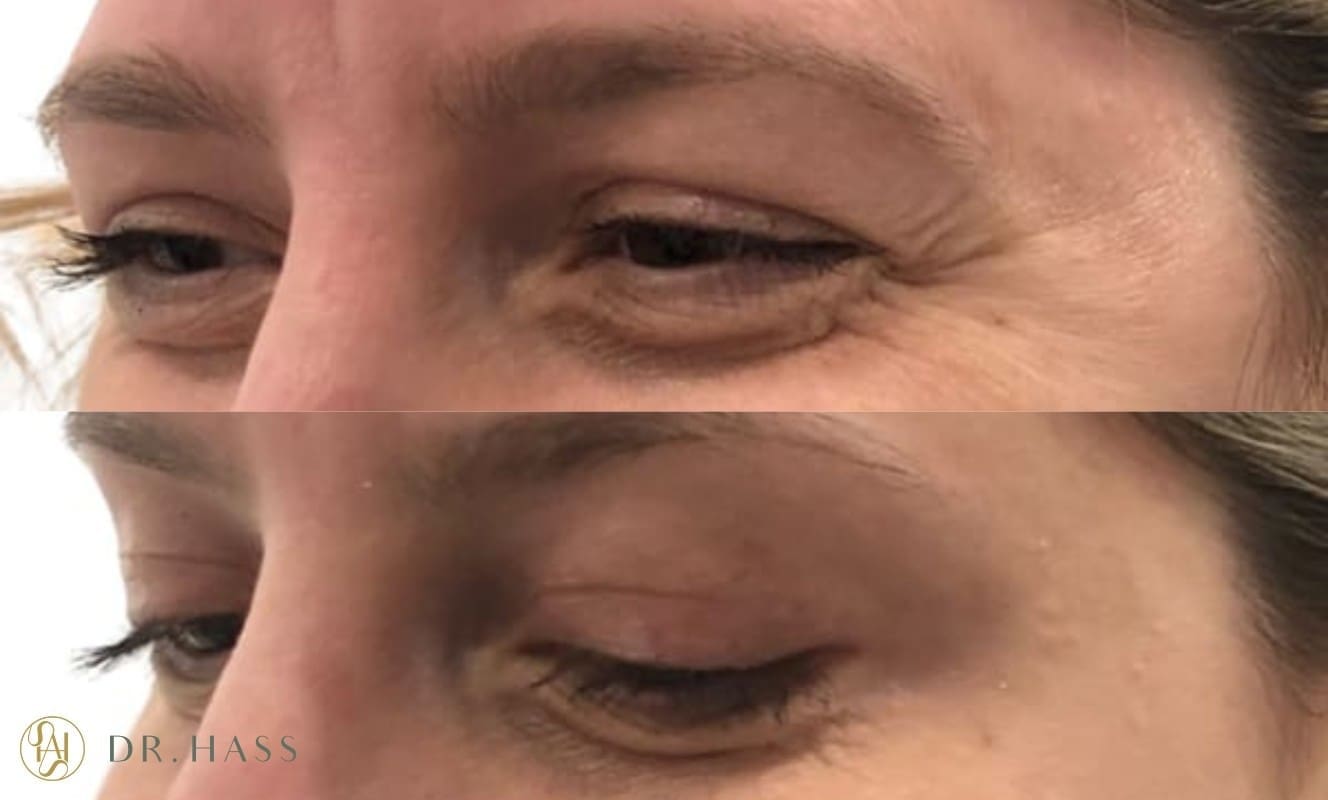
Crow's feet — 10 to 24 units total (5 to 12 per side)

The fine lines that fan out from the corners of the eyes when you smile are caused by the orbicularis oculi muscle contracting repeatedly over years of expression. The FDA-approved dose is 24 units total, or 12 units per side, and most treatments fall within 10 to 24 units depending on how prominent the lines are and how active the muscle is.

Crow’s feet tend to respond very consistently to treatment and the result is one of the more reliable across the whole face. Most patients see a clear smoothing within 5 to 7 days. One thing to be careful of here is over-injection, which can flatten the natural warmth of a smile and make the outer eye area look stiff. Precise placement at modest doses almost always looks better than a heavy hand.

Crow's Feet - Before and After Anti Wrinkle Injections - Dr Hass Clinic

Brow lift — 2 to 5 units per side

A small dose of Botox placed beneath the outer tail of the brow can relax the muscles that pull it downward, creating a subtle lift without any surgery. Typically 2 to 5 units per side achieves this effect.

It is worth being realistic about what a Botox brow lift can do. It opens the eye area and gives a more rested, refreshed look, but it is not going to replicate the result of a surgical brow lift. The degree of improvement depends significantly on where your brow sits naturally. It works best as part of a broader upper-face treatment rather than as a standalone procedure.

Bunny lines — 5 to 10 units total

Bunny lines are the diagonal creases that appear across the bridge of the nose when you scrunch your face. A dose of 5 to 10 units total into the nasalis muscle relaxes them effectively, and the result is predictable and consistent.

They often appear or become more noticeable after frown line treatment, because patients unconsciously compensate by scrunching the nose instead. Treating bunny lines as an add-on to a glabella and forehead session is very common for this reason.

Gummy smile — 2 to 4 units per side

When smiling reveals more gum than you would like, a very small amount of Botox injected into the upper lip elevator muscles can reduce how much the lip rises. Typically 2 to 4 units per side is all that is needed.

The results can be lovely, but this is an area where anatomy varies enormously between patients. The injection position and dose must be calibrated precisely to your lip and muscle structure. Too much product in the wrong place can affect the smile asymmetrically, which is why this treatment requires experience and a good understanding of the anatomy involved.

Gummy Smile Treatment - Before and After - Dr Hass Clinic

Lip flip — 4 to 6 units

A lip flip uses a few units of Botox along the upper lip border to relax the muscle there, which causes the lip to subtly roll outward and appear more defined. The standard dose is 4 to 6 units.

It is a modest treatment with a modest result. It adds definition and a little projection, but it does not add volume. If you are hoping for a meaningful difference in lip size, filler is the more appropriate option. Duration is also shorter here, typically 2 to 3 months, because the lip muscles are in almost constant use.

Chin dimpling — 2 to 6 units

An overactive mentalis muscle creates that dimpled, uneven texture on the chin sometimes described as “orange peel” skin. A small dose of 2 to 6 units smooths it out effectively. It is one of the more subtle applications of Botox, but patients who have it done are consistently pleased with the improvement.

If the concern with your chin is more about shape or projection rather than surface texture, filler is usually the better tool for that.

Downturned mouth corners — 3 to 6 units per side

The muscles that pull the corners of the mouth downward are called the depressor anguli oris. When they are overactive, the corners of the mouth drop and the face can look persistently sad or stern even when you are perfectly happy. Relaxing them with 3 to 6 units per side gives a gentle lift and a more neutral, rested expression.

For patients where volume loss is also contributing to the downturned appearance, a small amount of filler at the corners alongside Botox tends to give a more complete and longer-lasting result.

Masseter (jaw slimming) — 20 to 40 units per side

The masseter is one of the strongest muscles in the body, and it needs a correspondingly higher dose. Most patients need 20 to 40 units per side, with first-time patients often starting lower and increasing at subsequent sessions once the individual response is known.

Masseter Botox is one of the most requested treatments at Dr Hass Clinic, both for aesthetic jaw slimming and for patients dealing with teeth grinding and jaw tension. For a full breakdown of dosing, timelines, and what to realistically expect from the results, read our dedicated masseter Botox dosage guide.

Men and patients with very developed masseter muscles sometimes need up to 50 units per side. The slimming effect is gradual, becoming fully visible over 6 to 8 weeks as the muscle reduces in bulk.

Masseter Botox (Masseter Reduction) Before and After Results - Dr Hass Clinic London

Neck bands (platysmal bands) — 60 to 80 units total

As we age, the platysma muscle in the neck can develop visible vertical bands, particularly when the neck is tensed. Treating these typically requires 60 to 80 units in total, spread across the visible bands. Botulinum toxin recently received FDA approval for this specific indication, which adds weight to its clinical credibility in this area.

How many units are needed depends on how prominent the bands are and how many there are. Milder cases respond well to the lower end of the range; more established bands may benefit from a combination approach.

Nefertiti Neck Lift - What to Expect from Treatment - Before and After - Dr Hass Clinic

Trapezius (Traptox) — 50 to 100 units total

Traptox involves injecting Botox into the upper trapezius muscle, which runs from the base of the skull down to the mid-back. Relaxing it can relieve chronic neck and shoulder tension, elongate the neckline aesthetically, and in some patients create a slimmer shoulder silhouette. Because it is such a large muscle, doses range from 50 to 100 units in total, making it one of the higher-dose treatments available.

Results typically last 3 to 4 months in this area before tension and bulk begin to return.

What determines how many units you personally need?

The ranges above are your starting point, but where you land within them comes down to a handful of factors that vary from person to person.

  • Muscle strength and size. This is the biggest driver. Stronger, larger muscles need more product. It is why men consistently need higher doses than women across almost every treatment area.
  • How deep your lines are. Fine, early-stage lines respond to lower doses. Lines that are visible even at rest are deeper and may need higher doses, or a combination approach with filler, to see the best result.
  • How expressive you are. If you have a very animated face and contract your muscles frequently and forcefully, you will generally need more product and may find results fade a little sooner.
  • Your metabolism. Some people process botulinum toxin faster than others. A faster metabolic rate can mean both a slightly less pronounced peak effect and shorter duration between appointments.
  • Your treatment history. Long-term patients often find they need less product over time, as muscles that have been repeatedly relaxed gradually lose some of their bulk. First-time patients should expect to refine their dosing over the first two or three sessions.
  • What result you are after. A natural softening of lines with preserved expression needs fewer units than a complete freeze. Most patients want to look like a well-rested version of themselves, not a different person entirely, and that goal almost always favours starting with less rather than more.
Refining Treatment at Dr Hass Clinic

How many units for a full upper face treatment?

The most popular combination is frown lines, forehead, and crow’s feet treated together. The clinically established total for this combination is approximately 64 units: 20 for the glabella, 20 for the forehead, and 24 for crow’s feet. In real-world practice, individual anatomy means this figure moves up or down, but 55 to 70 units is a reasonable expectation for a full upper face treatment in most patients.

First-time patients: why starting conservatively is the right approach

A well-calibrated first treatment is more valuable than a heavy one. Starting at the lower end of the clinical range lets your practitioner see how your specific muscles respond before committing to higher doses. It reduces the risk of the two most common first-treatment problems: a heavy brow from over-treating the forehead, or asymmetry where one side responds differently to the other.

A two-week review appointment after your first treatment means any areas that need a small top-up can be addressed before you leave the assessment window. It is a better experience overall, even if it occasionally means a second small appointment, rather than waiting out an over-treated result.

Consultation 2 at Dr Hass Clinic

What happens at Dr Hass Clinic

Dr Hasaneen Al-Janabi is a GMC-registered surgeon who has performed thousands of anti-wrinkle injection treatments at the clinic’s Mayfair practice. His approach is anatomy-led and unhurried: every consultation involves a thorough assessment of your facial muscle activity, a clear conversation about what is realistic for your specific concerns, and a dosing plan built around your face rather than a standard protocol.

If you have been researching Botox and are wondering whether it is the right treatment for you, or you have had treatment elsewhere and want a second opinion on your dosing, a consultation with Dr Hasaneen will give you a clear, honest picture. There is no pressure to proceed, and if something other than Botox would serve you better, that is what he will tell you.

Latest News

Don’t Take Our Word For it…

Our clients’ satisfaction is at the heart of everything we do. We take immense pride in helping individuals enhance their natural beauty and boost their confidence.

Dr Hass Surgeon-led Aesthetic Clinic Mayfair Waiting Area Dr Hass Clinic - Luxury Aesthetic Clinic Mayfair

Our Clinic

Your Sanctuary

Welcome to our clinic, where innovation, expertise, and personalised care merge to redefine your natural beauty. We specialise in providing a wide range of non-invasive treatments that deliver remarkable results without the need for surgery.

Call us — 020 8168 8178

or